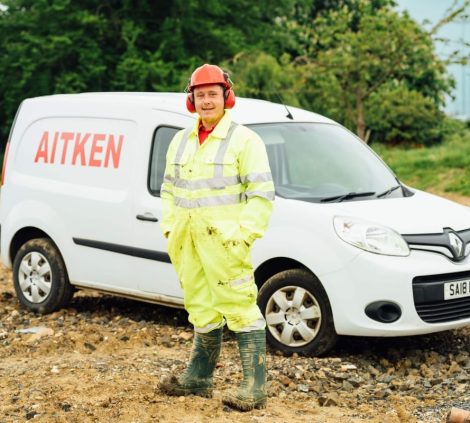
Aitken Laboratories carries out in-situ geotechnical testing on site across Scotland and the North of England, giving you accurate ground data without waiting for material to reach a lab. Our field testing includes in-situ CBRs, plate load and plate bearing tests, sand replacement tests and percolation and soakaway tests, delivered by an experienced team to recognised standards.
Use in-situ testing to verify ground conditions and support your design where on-site measurement matters.
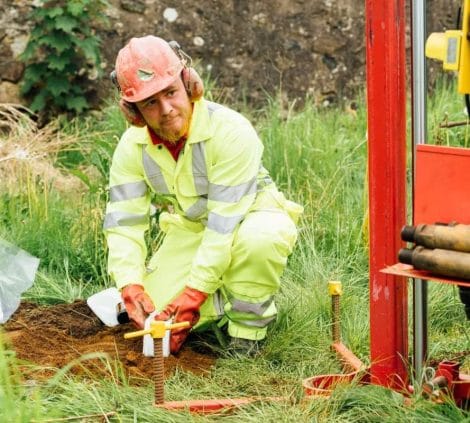
The California Bearing Ratio (CBR) test is a vital in-situ testing method used to evaluate the strength and bearing capacity of soils for road construction and pavement design. It involves measuring the soil’s resistance to penetration by a standard plunger. This test is performed directly at the project site, providing a realistic assessment of the soil’s bearing capacity and its suitability for supporting road and pavement structures.
Sand replacement testing is a crucial method for determining the in-situ density of soil, essential for assessing soil compaction and suitability for construction projects. Sand replacement testing involves removing a soil sample from a test site and filling the void with a known quantity of sand. By measuring the volume of sand used to fill the void, the density of the in-situ soil can be accurately calculated. This method is widely used to evaluate soil compaction and ensure that it meets the required specifications for construction.
Plate load testing is a vital field test used to determine the bearing capacity and settlement characteristics of soils and pavements under load. Plate load testing involves applying a controlled load to a steel plate placed on the ground surface or a prepared subgrade. The test measures the soil’s response to the load, providing valuable information about its bearing capacity and settlement behaviour. This data is crucial for designing foundations, pavements, and other load-bearing structures.
Percolation and soakaway tests are essential methods used to evaluate the infiltration rate of soil, which is crucial for designing effective drainage systems, soakaways, and septic systems. Percolation testing involves digging a test pit and filling it with water to observe how quickly the water percolates into the soil. This test measures the soil’s infiltration rate, which is essential for designing drainage solutions. Soakaway tests are similar but focus specifically on the capacity of the soil to absorb stormwater runoff, ensuring that soakaways and drainage systems are properly designed to prevent flooding and waterlogging.
Independent and unbiased: as an independent firm, we provide objective and reliable results.
Experienced team: our team consists of seasoned professionals with extensive industry experience.
Commitment to quality: we adhere to the highest standards of quality and safety in all our operations, and we implement rigorous quality control measures to ensure the highest standards of accuracy and reliability.
Client-focused approach: we work closely with our clients to understand their specific project needs and provide tailored solutions.
Comprehensive reporting: our detailed reports offer clear, actionable insights to support your project planning and decision-making.